
IoT at gold mine
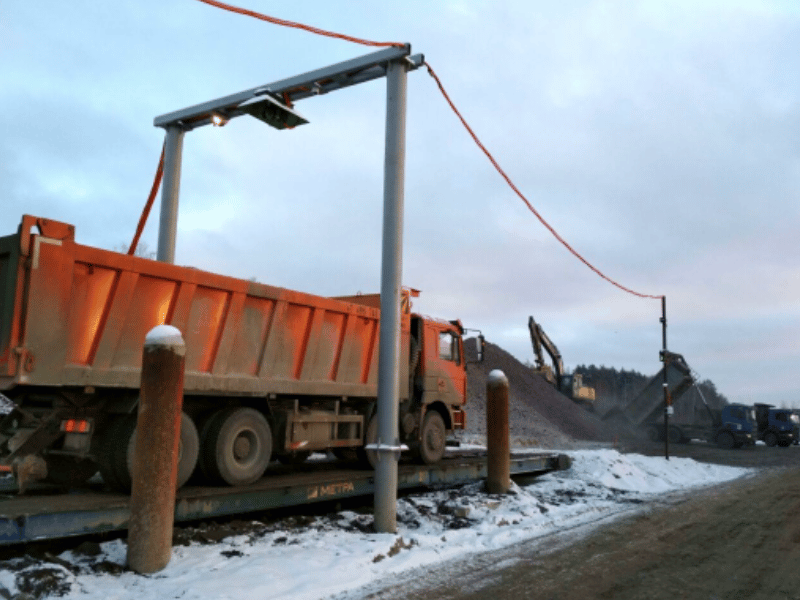
3D laser scanner / truck weight key data
- Client: Friedrich Telematik in Germany, newTelematics (Burkina Faso)
- Website: www.Friedrich-Telematics.de
- Consultant: Antennity (Harald Naumann) – connectivity architecture, Starlink recommendation
- IoT application: Lorry load inspection with 3D volume measurement and weight recording
- Wireless technology used: Starlink at Lorry load inspection
- Frequency range: Downlink (satellite → antenna): 10.7–12.7 GHz (or, more specifically, 10.95–12.7 GHz), Uplink (antenna → satellite): 14.0–14.5 GHz
- Antenna types: Antenna array by Starlink
- Task: Consultinh on connectivity architecture, Starlink recommendation
System Overview
High-precision laser measurement system for automatic, dynamic lorry volume measurement whilst in motion. Used for stones, sand, ore, and timber products.
Measurement Principle:
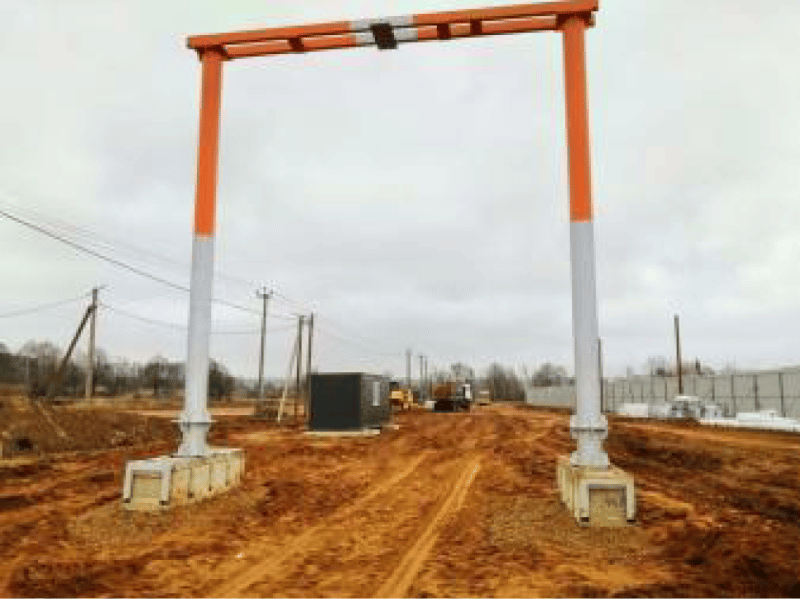
- 2× 2D Laser Scanners: One measures load cross-section, one tracks lorry position
- Camera: Captures number plates for data assignment
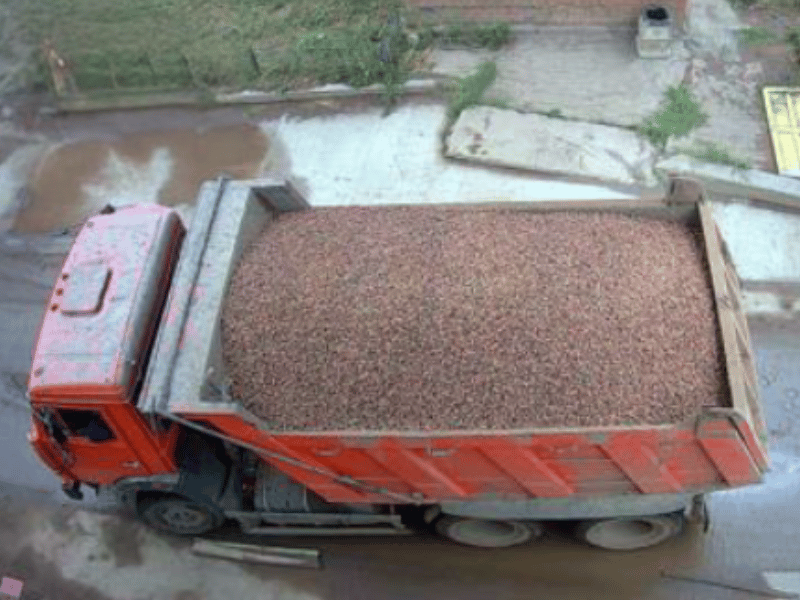
- Process: Lorry measured empty and full; difference gives exact load volume
Measurement Procedure (Ore & Gold)
- Weigh (empty): Lorry weighed, number plate recorded
- Scan (empty): 3D scanner measures empty load bed volume
- Weigh (loaded): Loaded lorry weighed
- Scan (loaded): 3D scanner measures loaded volume
- Calculate: Density = weight / volume; metal content estimated (Gold: 19,3 g/cm³)
Key Technical Data
| Parameter | Specification |
|---|---|
| Scanner Type | 2× 2D laser (dynamic) or 1–2× 3D laser (static) |
| Accuracy | approx. 98% (variance ±2%) |
| Measurement Time | approx. 10 seconds |
| Temperature Range | −25 °C to +50 °C |
| Interface | Ethernet TCP/IP |
| Power Supply | 230 V AC |
Metal Densities (g/cm³): Aluminium 2,7 | Eisen 7,9 | Kupfer 8,9 | Silber 10,5 | Blei 11,3 | Gold 19,3 | Platin 21,5
Note: Tolerance varies with rock moisture and metal content.
System Components
- Truck Weighbridge: For empty and laden weights
- Metal Frame: Support structure for 3D scanner (drive-through)
- Control Cabinet: PC/software for data processing
- Camera: Weatherproof number plate recognition
Antennity’s Role
Antennity (Harald Naumann) designed the connectivity architecture:
- Connectivity Analysis: Evaluated 4G/5G vs. satellite (LEO) for Burkina Faso
- Technology Recommendation: Starlink selected for required upload bandwidth
- System Integration: Ensured reliable data transmission from scanner, camera, and weighbridge
Why Starlink?
Conventional satellite (VSAT/GEO) offers only 1–5 Mbps upload—too slow for 3D point clouds and camera images. Starlink (LEO) provides:
| Parameter | Value | Project Relevance |
|---|---|---|
| Download | 50–250 Mbps | Remote maintenance, dashboard access |
| Upload | 10–30 Mbps | Critical: Scanner data + camera images |
| Latency | 25–60 ms | Real-time processing |
A 1080p camera image needs 1–2 Mbps; 3D scanner data 0,5–5 Mbps per measurement. With 10–30 Mbps upload, multiple measurement points can operate in parallel.
Data Flow
- Acquisition: 3D scanners and camera capture volume and number plates
- Pre-processing: Local PC/PLC calculates volume, assigns number plates
- Transmission: Data packet (volume, weight, image, number plate) sent via Starlink router
- Analysis: Central software calculates density and metal content, displays on dashboard
Starlink connects the remote mine in Burkina Faso to the head office or cloud for further processing.
Technical Classification
Antennity has demonstrated that satellite IoT (NTN, Non-Terrestrial Networks) is suitable not only for simple telemetry (e.g., GPS trackers) but also for data-intensive applications like 3D measurement systems. The combination of local measurement technology and satellite-based connectivity enables deployment in regions without mobile network coverage.
Optimise Your Industrial IoT Communication
Are you struggling with similar challenges in your industrial environment? Our experts can help you find the optimal connectivity solution. Contact us today for a consultation. Together, we will increase the performance and reliability of your wireless IoT devices.