
N-Tester Bluetooth/GPS
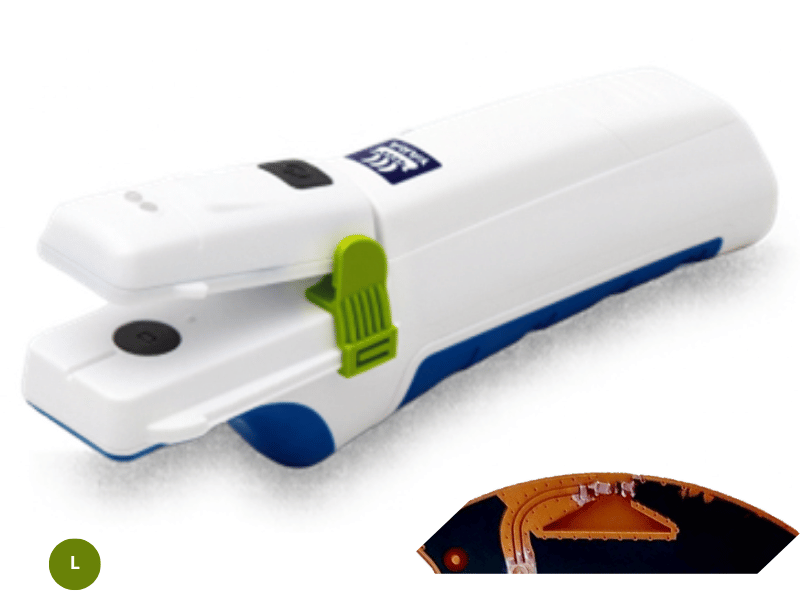
N-Tester key data
- Client: Yara International
- Website: yara.com
- Application: Handheld device for determining the nitrogen requirements of cereal crops
- Wireless Technology: Bluetooth Low Energy (BLE) and GPS
- Frequency Range: 2.4 GHz for BLE; GNSS bands for satellite reception
- Original Antenna Type: Classic PCB track antenna in a monopole configuration
- Antenna Type After Optimisation: FreeLoop antenna
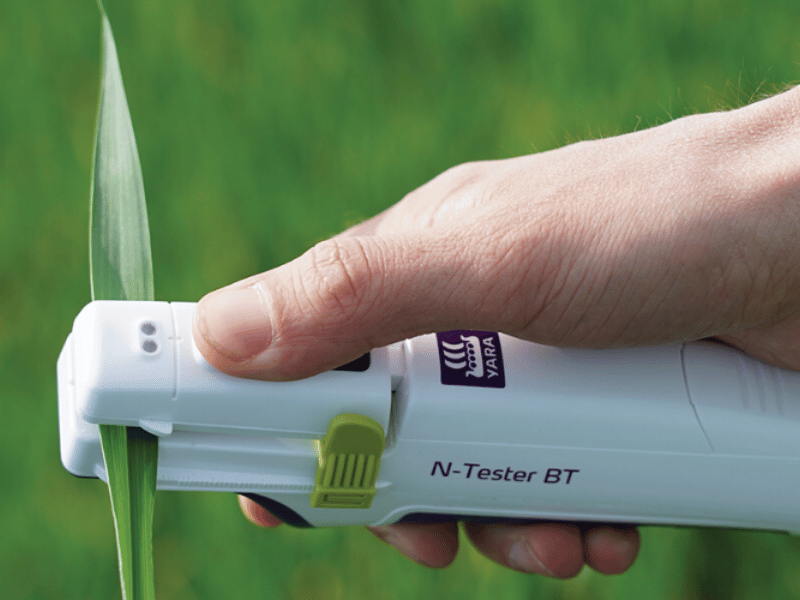
- Special challenge: Operation held directly in the hand with highly variable hand position
- Special advantage: Low hand and body effects of the loop antenna
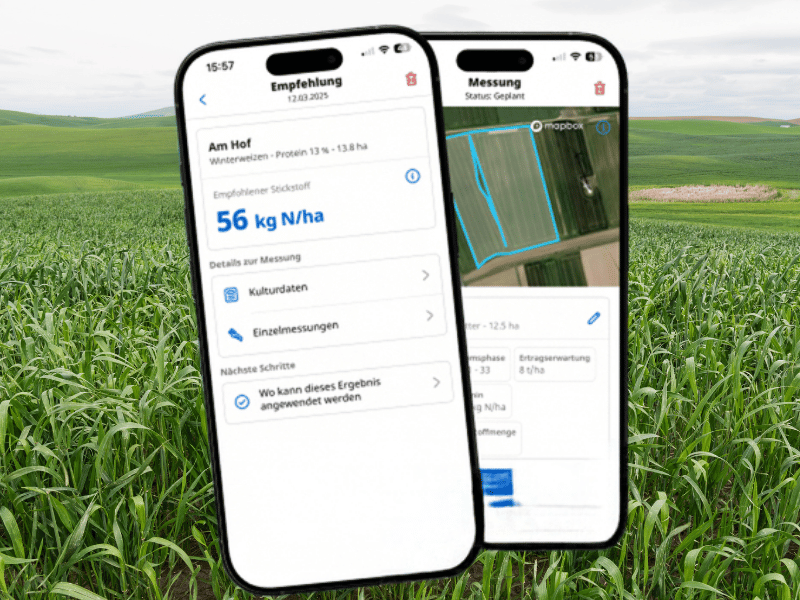
The Yara N-Tester BT measures the chlorophyll content of leaves. Based on the measured values, the app calculates a recommendation for nitrogen fertilization. Farmers can use this to more precisely determine the nitrogen requirements of their crops and adapt fertilization to the variety, growth stage, expected yield, and other field conditions.
To do this, the device must communicate reliably with a smartphone. At the same time, it requires a compact design that is comfortable to use during daily field operations.
The original PCB-track antenna functioned as a classic monopole antenna. This type of antenna is sensitive to its surroundings. When operated by hand, the human body alters the antenna’s electrical length, impedance, and radiation pattern. The hand can also absorb RF energy. This degrades the Bluetooth range, and the wireless connection can become unstable. GNSS reception also poses significant challenges. Satellite signals reach the device with very low power. The antenna must therefore deliver reception performance that is as stable as possible despite a small ground plane, the influence of the housing, and changing hand positions.
Solution with the Antennity FreeLoop Antenna
Antennity replaced the traditional GPS PCB track monopole antenna with a GPS FreeLoop antenna. The loop structure couples significantly less strongly to the human body than an electrical monopole antenna. As a result, its resonance remains more stable when the device is held in the hand.
The development process did not focus solely on the antenna. The team optimized the entire RF structure:
- The antenna and ground plane of the printed circuit board.
- The battery, display, sensors, and other conductive components.
- The housing and mechanical clearances.
- Non-conductive materials in the immediate near field.
- Typical hand positions during measurement and operation.
- GNSS reception under real-world operating conditions.
This holistic approach is crucial. An antenna that produces good readings in open space does not automatically function well when installed in a device. Especially with a handheld device, the user influences the RF parameters during every measurement.
The FreeLoop antenna reduces this influence. It thereby enables a more reliable more stable GNSS reception. At the same time, the compact design of the measuring device is preserved.
Benefits for Yara
The N-Tester BT combines mobile field measurements with digital analysis in the YaraPlus or Atfarm app. The app guides the user through the measurement process and can derive specific recommendations for the next fertilizer application based on the results. For optimal results, the current procedure calls for 30 measurements.
The optimized antenna solution offers several advantages:
- Reduced sensitivity to hand position.
- More stable RF characteristics when installed.
- Support for GNSS reception in a compact device.
- Lower risk of range issues in practical use.
- Retention of the compact design despite a limited ground plane.
- Better conditions for reproducible measurement procedures in the field.
In this way, the antenna design supports the product’s primary purpose: enabling farmers and consultants to assess crops quickly, reliably, and directly in the field. The measurement data then forms the basis for a more precise nitrogen management strategy.

Antenna Development for Your IoT Device
Does your antenna need to function reliably even when held in the hand, housed in a casing, or located directly next to the battery and electronics?
Antennity develops and optimizes antennas for demanding IoT devices. We support you with antenna matching, complete antenna development, and the development of complete IoT devices. From the very beginning, we take into account the ground plane, housing, near field, conductive components, and real-world usage. Contact us if your product needs to transmit reliably despite its compact dimensions.